Complexity vs. Complication: Understanding the Crucial Difference
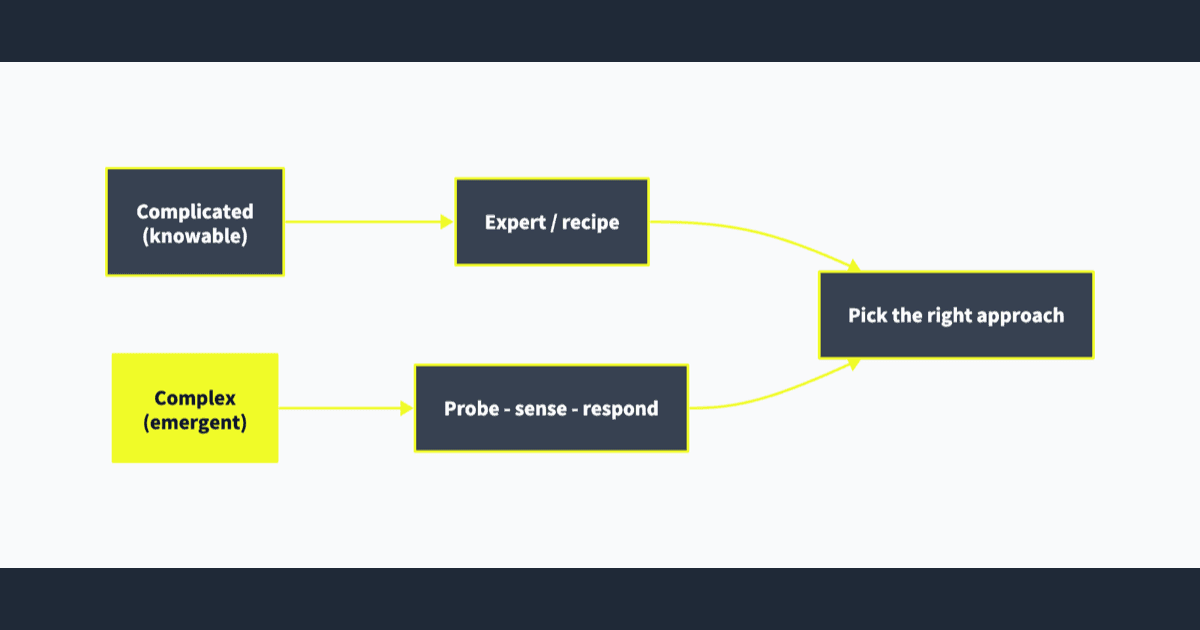
In the world of business, technology, and project management, we often use the terms "complex" and "complicated" interchangeably. However, distinguishing between these concepts is not merely a semantic exercise—it represents a fundamental shift in how we approach problem-solving and system design.
What Makes Something Complicated?
A complicated task or system is characterized by its scale and intricate components, but with fundamentally stable and predictable behavior. Complications arise from:
- Volume and scale: The sheer number of components or steps involved
- Technical difficulty: Specialized knowledge required for individual subtasks
- Clarity issues: Unclear objectives or specifications within a large task
- Resource intensiveness: High demands on time, expertise, or computational power
Think of a mechanical watch. It has hundreds of precisely engineered parts working together in a predictable manner. While disassembling and reassembling it would be extremely complicated, the behavior of the watch follows deterministic rules.
What Makes Something Complex?
Complexity, in contrast, emerges when a system or task exists within constantly shifting boundary conditions:
- Dynamic environments: External factors that continuously evolve
- Emergent behaviors: The whole behaves in ways not predictable from individual parts
- Feedback loops: Changes in one area affect other areas, which then cause further changes
- Adaptation requirements: Solutions must evolve as the problem itself transforms
Weather systems exemplify complexity. Despite our sophisticated models and massive computing power, we cannot perfectly predict weather because it's a complex system with countless variables interacting in non-linear ways.
Understanding the Stacey Matrix
One powerful tool for distinguishing between different types of challenges is the Stacey Matrix, developed by Ralph Stacey in the 1990s. This framework helps organizations determine appropriate management approaches based on the levels of know-how and requirements present in a situation.

The Stacey Matrix maps problems across two dimensions:
- Know-how: How well we know how to do the work (methods, practices, expertise)
- Requirements: How clear, stable, and agreed the needs and outcomes are
In other words, when know-how is high, proven practices exist and we can rely on expertise to deliver. When requirements are clear, stakeholders agree on what “good” looks like and it is unlikely to change. As know-how decreases or requirements become more fluid, we move toward complexity and chaos where experimentation and rapid feedback become essential.
This creates four primary domains:
- Simple/Clear (High know-how, clear requirements): Well-understood problems with established solutions
- Complicated (High know-how, mostly clear requirements): Problems requiring expertise but with predictable outcomes
- Complex (Emerging know-how, evolving requirements): Problems where cause and effect are only understood in retrospect
- Chaotic (Unknown know-how, unclear requirements): Crisis situations with no clear patterns
Understanding where your challenge falls on this matrix helps determine whether you need established best practices (for simple problems), expert analysis (for complicated problems), emergent practices through experimentation (for complex problems), or novel approaches (for chaotic situations).
A Practical Example: Variant Configuration
Consider the domain of product variant configuration in manufacturing:
Setting up the system
The Complicated Aspect: Setting up a product configuration system with thousands of options, constraints, and rules is undeniably complicated. It requires significant technical expertise, careful planning, and meticulous implementation.
Managing continuous change
The Complex Aspect: Maintaining this configuration system becomes complex when:
- Market demands shift unexpectedly
- New regulatory requirements emerge
- Supply chain disruptions force material substitutions
- Competitor actions require rapid adaptation
- Customer preferences evolve over time
The initial setup, no matter how complicated, followed a relatively stable set of requirements. The complexity emerges when managing this system under continuous change from external forces that interact with each other in unpredictable ways.
Approaches to Handling Complication vs. Complexity
Addressing Complicated Challenges:
- Break down into manageable components
- Apply specialized expertise
- Create detailed documentation
- Implement rigorous testing protocols
- Optimize for efficiency
Navigating Complex Environments:
- Design for adaptability rather than optimization
- Implement feedback mechanisms for early detection of changes
- Favor simple, modular solutions that can evolve
- Build slack and redundancy into systems
- Create cross-functional teams with diverse perspectives
Why Scrum Works for Software Development Teams
Software development inherently lives in the complex domain of the Stacey Matrix, which explains why traditional project management approaches often fail while agile methodologies like Scrum excel.
Software Development as a Complex Endeavor
Software projects typically exhibit key characteristics of complexity:
- Continuous change: Requirements evolve as users interact with the system
- Emergent behavior: Interactions between components create unpredictable scenarios
- Human factors: User expectations shift over time
- Technical uncertainty: New technologies and integrations introduce unknown variables
- Market pressures: Competitive landscape changes during development
How Scrum Addresses Complexity
Scrum was specifically designed to navigate complex environments through:
- Iterative development: Short sprints create feedback loops that allow for course correction
- Empirical process control: Decisions based on what is actually happening, not just what was planned
- Self-organizing teams: Diverse perspectives collaborate to tackle emerging challenges
- Regular inspection and adaptation: Sprint reviews and retrospectives provide mechanisms to respond to change
- Incremental delivery: Working software delivered frequently allows testing assumptions against reality
Unlike waterfall approaches that assume a complicated but stable problem space, Scrum embraces complexity by creating a framework for continuous adaptation. This makes it particularly well-suited for software development, where both the problem and solution spaces evolve simultaneously.
Real-world Benefits
Software teams using Scrum effectively report:
- Faster response to market changes
- Higher customer satisfaction through regular feedback integration
- Reduced risk through early issue identification
- Improved team problem-solving capabilities
- Better alignment between business needs and technical implementation
By acknowledging software development as a complex domain rather than merely a complicated one, Scrum provides the adaptability needed to navigate uncertainty while maintaining focus on delivering value.
Why the Distinction Matters
Understanding whether you're facing a complicated or complex challenge fundamentally changes your approach:
-
Resource allocation: Complicated problems benefit from specialized expertise and detailed planning; complex problems require adaptable teams and flexible resources.
-
Success metrics: For complicated tasks, efficiency and precision are key; for complex situations, adaptability and resilience matter more.
-
Risk management: Complicated challenges have identifiable risks that can be mitigated; complex environments require constant vigilance for emerging risks.
-
Leadership approach: Complicated projects need strong technical leadership; complex situations benefit from adaptive leadership that empowers rapid response.
Conclusion
In our increasingly interconnected world, we face both complicated and complex challenges. Recognizing which type we're dealing with helps us choose the right tools, mindsets, and approaches.
Complicated systems can be mastered through expertise, analysis, and precision. Complex systems must be navigated through adaptability, experimentation, and continuous learning.
The most successful organizations develop capabilities for handling both types of challenges—building the technical expertise to tackle complication while fostering the adaptability to thrive amid complexity. For software teams in particular, embracing frameworks like Scrum acknowledges the fundamentally complex nature of their work and provides a structured approach to harness that complexity rather than fight against it.